

How to Roll Out One HR Policy Across Maharashtra Sites

A policy can be consistent across Maharashtra sites and still require different operating instructions. An office team in Mumbai may use one request channel and one manager review window. A plant in Pune may need a shift-based handoff and a backup approver. Start with the decision that must be consistent. Then document the local steps that help the employer actually apply it.
Separate the policy decision from the operating steps
Create a common policy record with the outcome, decision owner, eligibility or applicable boundaries verified by advisers, approval conditions, route for questions and effective date. Keep the policy version under one owner. Use a local operating addendum for workflows such as routing, shift cutoff, local approver, languages needed to communicate the process and the escalation path. Ask the qualified owner to confirm where legal, site or employment conditions require different treatment.
For every alleged local exception, ask which part of the work changes. If the plant needs a different cutoff to make a roster, document the operational reason and test that the decision is still fair and consistent with the approved policy. If a site is changing a right or condition, route that question for qualified review. A practical addendum should be short, approved and linked to the correct policy version. Remove conflicting manager instructions as part of rollout.
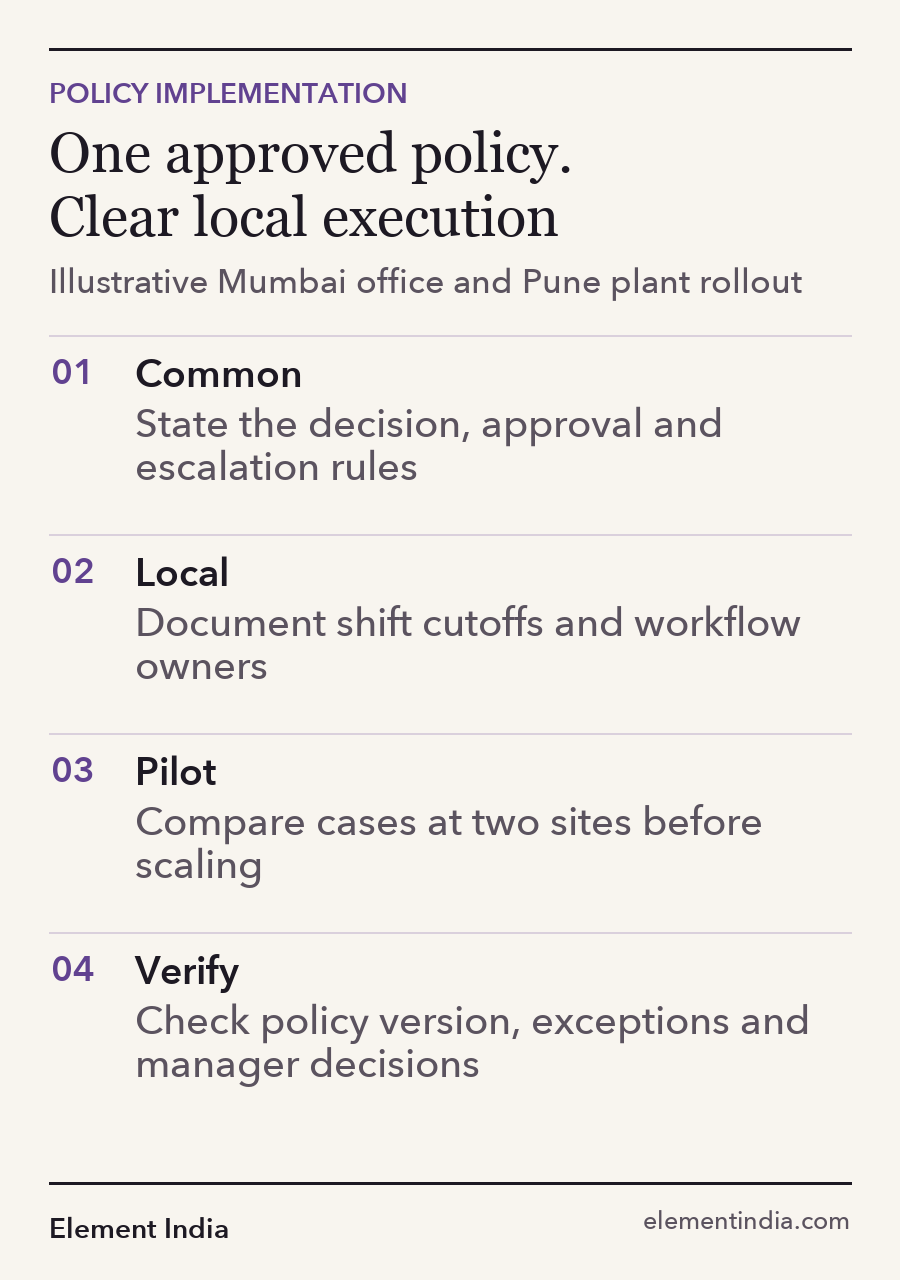
Pilot the same decision at two different sites
Consider an illustrative employer with a Mumbai office and a Pune plant. The leave workflow needs an agreed approval route and a named backup. The office pilot checks how requests are recorded and who owns approvals when the manager is out. The plant pilot also checks how upcoming shift coverage is coordinated and confirms that urgent requests have a clear route. Test the same three scenarios at both sites: complete request, unavailable approver and disputed response. Compare which owner handled the issue, how long the decision took and how the worker learned the outcome.
The rollout gate is observable. Both sites use the approved policy version. Managers can find their decision limits. An employee can see where to submit a request and how to raise a concern. Exceptions appear in one reviewed log with the site, reason and decision owner. If an issue remains unresolved, keep the documented interim route and schedule a verification. A launch email alone gives little evidence that the policy works in a night shift or an understaffed office.
Define what maintenance looks like
Record policy owner, local procedure owner, retained approvals, version, evidence of manager instruction and the next review. Check a small sample of decisions across sites after launch and track recurring exceptions. If several sites invent the same workaround, determine whether the policy language, intake or approval path needs revision. Tell managers which version is active and how to check their local steps.
The GAO Green Book is a reference for responsibilities, documentation and ongoing monitoring in a U.S. public-sector setting. Here, those principles are applied to an illustrative private employer workflow. For local delivery, see HR consulting services in Mumbai, HR consulting in Pune and HR policy and handbook support. GAO Standards for Internal Control

The HRMS Vendor Demo Your Team Should Run
An HRMS demo should answer whether the system can run your real workflows. A tour of dashboards rarely reveals what happens when a manager changes, a record is corrected or a supplier relationship ends. Give every vendor the same scenarios and make the demonstration evidence part of your decision. Write scenarios around the exceptionSelect a short list of high-frequency and high-consequence processes. For an onboarding demo, ask the vendor to create a synthetic hire, send a request to the...

Protect Employee Survey Confidentiality in Small Teams
Employee survey confidentiality depends on what different audiences can see together. A team may meet its reporting threshold in one view and still become identifiable after someone compares a parent group, a sibling team and a filter. Decide publication and access rules before designing the dashboards. Start with the outcome you can promise truthfully about the tool and process. Trace where answers can be identifiedMap what is collected, whether identifiers or links to individuals exist, who...

Build an Executive Search Scorecard Around the Mandate
Executive interviews often reward candidates who narrate their experience well. A board still needs evidence that the person can do the work of this particular mandate. Define the outcomes before the search begins. An interview scorecard can then show where the panel has strong evidence, where it has an unresolved risk, and which follow-up will inform the decision. Translate the role into observable outcomesStart with the business problem. A leader hired to stabilize a new site faces...

